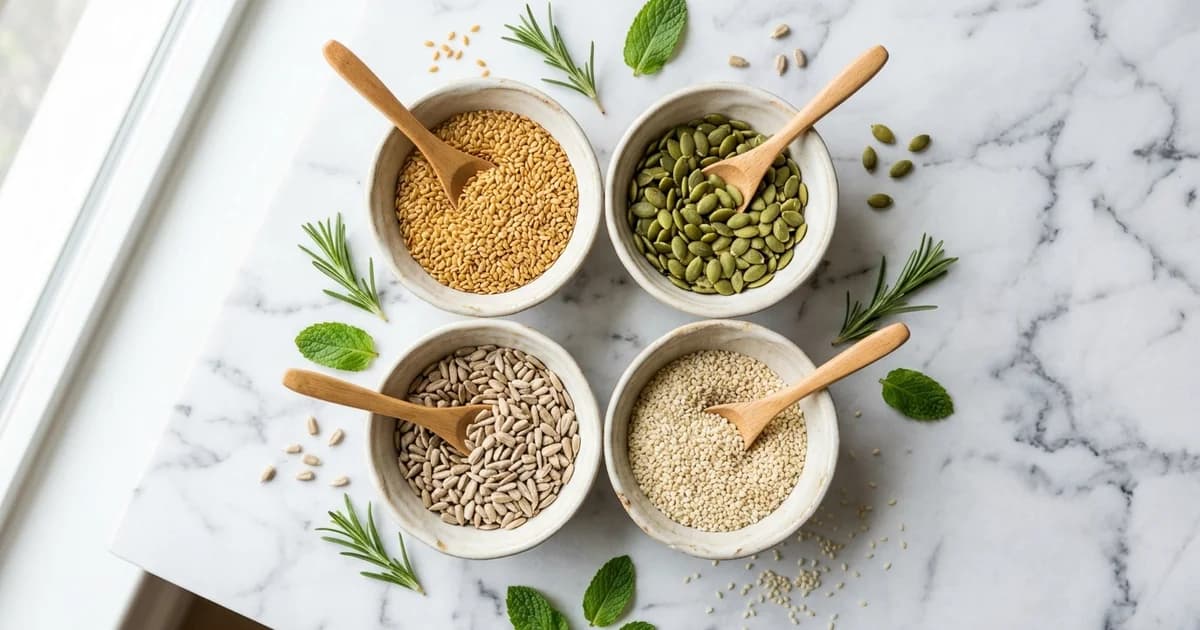
Someone on Instagram told me to eat seeds in a specific rotation to "balance my hormones." My first reaction was skepticism. My second reaction, after actually reading the research on the individual seeds, was more nuanced. Seed cycling sits in an awkward space: the method is simple, the seeds themselves are genuinely nutritious, but the direct evidence for the protocol as a whole is thin.
I'm Marie from bauchgefühl.app, and this is my honest take. I'll walk you through what seed cycling is, why people do it, what the science actually says about each seed, and whether it's worth trying.
The Seed Cycling Protocol
The idea is straightforward. You eat specific seeds in the first and second halves of your menstrual cycle:
Follicular phase (roughly days 1 to 14): 1 tablespoon of ground flaxseeds and 1 tablespoon of raw pumpkin seeds per day.
Luteal phase (roughly days 15 to 28): 1 tablespoon of ground sesame seeds and 1 tablespoon of raw sunflower seeds per day.
If your cycle is irregular or you don't menstruate (due to menopause, hormonal birth control, or amenorrhea), some practitioners suggest syncing with the moon phases instead: new moon to full moon as "follicular," full moon to new moon as "luteal." That part has zero scientific backing, but the seeds are still nutritious regardless of timing.
The seeds need to be ground (or at least well-chewed) for flax and sesame, because whole seeds pass through your digestive tract intact. Pumpkin and sunflower seeds can be eaten whole. Store ground seeds in the fridge or freezer to prevent the oils from going rancid.
Why These Specific Seeds?
Each seed was chosen for specific nutrients that, in theory, support the dominant hormone of that cycle phase. The logic goes like this:
Follicular Phase Seeds: Flax and Pumpkin
Flaxseeds are the richest dietary source of lignans, a type of phytoestrogen. Lignans are metabolised by gut bacteria into enterolactone and enterodiol, which can weakly bind to estrogen receptors. The theory is that during the follicular phase, when estrogen is rising, flax lignans help modulate estrogen activity: this is a proposed mechanism, not evidence that eating flax corrects high or low hormone levels.
A small randomised crossover study from 1993, PMID 8077314, involved 18 normally cycling women. It compared diets with and without flaxseed and observed a longer average luteal phase with flaxseed, without a significant rise in luteal progesterone concentration. It did not test rotation of four seeds or establish a treatment for PMS.
Omega-3 terms, simply explained: ALA stands for alpha-linolenic acid, the omega-3 fat found in flaxseed and walnuts. EPA (eicosapentaenoic acid) and DHA (docosahexaenoic acid) are other omega-3 fats found in oily fish and certain algae oils. Your body converts only a limited amount of ALA into EPA and DHA. More on these differences: NIH.
Flaxseeds also provide ALA omega-3 fatty acids and fibre. Their nutritional value does not establish a benefit from eating them on particular cycle days.
Pumpkin seeds provide zinc, magnesium and iron. A nutrient’s role in normal body function does not show that extra pumpkin seeds will correct an irregular cycle. The contribution depends on the product and portion weight.
Luteal Phase Seeds: Sesame and Sunflower
Sesame seeds provide lignans and minerals. Calcium content varies substantially with whether the seeds are hulled. These nutrients do not establish a progesterone-boosting effect from sesame.
Sunflower seeds provide vitamin E and other nutrients. Studies of vitamin supplements cannot be used as proof that sunflower seeds, or a timed rotation, relieve PMS.
What the Evidence Actually Supports (and Doesn't)
Separate the nutritional value of seeds from evidence for the rotation. The sources discussed here do not establish the four-seed schedule as an effective treatment for cycle symptoms. A small study of flaxseed alone cannot answer whether alternating four seeds is better than eating a mixed selection.
Anecdotes also cannot separate the timing from other dietary changes or the natural variation in symptoms. Describing the protocol as a proven way to balance hormones would overstate these sources.
The Harvard T.H. Chan School of Public Health page on soy and phytoestrogens provides background on plant compounds; it does not test seed cycling.
Personal Experience and Its Limits
A routine can change several things at once: you may prepare breakfast more often, eat more seeds and pay closer attention to your cycle. If you feel different afterwards, that does not identify which change mattered. Personal impressions cannot establish that the seed rotation changed hormones, skin or mood.
You can keep a food routine because you enjoy it without needing to claim a specific hormonal effect. There is no requirement to rotate the seeds to include them in balanced meals.
How to Actually Do It
Practicality matters more than perfection here. These are the tips that have made it stick for me.
Grind your seeds. A cheap coffee grinder works. I grind a week's worth of flax and sesame at a time and keep them in a jar in the fridge. Grinding makes the seed contents more accessible than when whole seeds pass through with little chewing. Follow storage and preparation instructions on the product.
Add them to what you already eat. I put my seeds on porridge, in yogurt, on salads, blended into smoothies, or stirred into nut butter on toast. You don't need a special "seed cycling recipe." Just sprinkle them on whatever you're having.
Track your cycle. You need to know roughly what day you're on. Any tracking app works, or a simple note in your calendar. Bauchgefühl obviously does this, but I'm biased.
Don't stress about exact days. If ovulation happens on day 15 instead of day 14, switching your seeds a day late won't ruin anything. The protocol is a loose framework, not a pharmaceutical dosing schedule.
Choose products suited to the recipe. Unsalted seeds make seasoning easier to control. Some flax products require cooking; follow that instruction rather than assuming raw is always preferable.
Do not set a treatment deadline. These sources do not establish that a certain number of cycles produces a benefit. You do not need to continue a routine you dislike while waiting for promised results.
Who Might Enjoy the Routine
It may suit someone who likes seeds, wants new meal ideas and finds a simple routine useful. That is a food preference, not an indication for treating mild PMS or irregular periods. Allergies, digestive tolerance and individual medical needs still matter. Seeds do not replace assessment of PCOS, thyroid disease, endometriosis or other causes of symptoms.
What Seed Cycling Won't Do
A few claims I've seen online that go too far:
"Seed cycling cures PCOS." No. PCOS involves insulin resistance, androgen excess, and often structural ovarian changes. Seeds can be part of a healthy diet for PCOS, but they're not a cure. The NHS PCOS page outlines what evidence-based management actually looks like.
"Seed cycling replaces hormone therapy." Also no. If you've been prescribed hormonal medication, seeds are not an equivalent substitute. Talk to your prescribing doctor before changing anything.
"Seed cycling will regulate your cycle within one month." The cited evidence does not establish this claim, or an alternative three-to-six-month deadline. Do not delay assessment of concerning symptoms while waiting for the protocol to work.
The Nutrients at a Glance
Flax provides fibre, ALA and lignans; pumpkin seeds provide zinc and magnesium; sesame provides lignans and minerals; sunflower seeds provide vitamin E and other nutrients. Amounts vary by product, hulling and portion weight. A tablespoon is not a standard nutrient dose, so use product data when you need a precise calculation.
The Harvard Health guide to nuts and seeds is general nutritional background, not proof of the rotation’s effectiveness.
Frequently Asked Questions
Can I eat all four seeds every day instead of rotating?
You can, and you'd still get the nutritional benefits. The rotation is based on the theory that specific nutrients support specific hormonal phases, but the sources presented here do not establish that one approach is better. If rotation feels like too much tracking, eating a mix of all four seeds daily is a perfectly reasonable alternative.
Do I need to buy organic seeds?
Organic certification is not a requirement of this food routine. Choose according to your budget, preferences and the product’s preparation instructions; an organic label does not establish a hormonal benefit.
Can men do seed cycling?
The nutrients in these seeds are beneficial for everyone: zinc, magnesium, omega-3s, vitamin E, and fibre aren't gender-specific. The hormonal rotation theory is built around the menstrual cycle, so the timing aspect doesn't apply to men, but eating a tablespoon or two of mixed seeds daily is a solid nutritional habit regardless.
Will seed cycling interact with hormonal birth control?
Eating seeds does not replace your prescribed contraception, and the rotation does not restore a natural ovulatory cycle suppressed by hormonal contraception. This article cannot assess individual interactions. Ask your pharmacist or prescriber about concerns, especially supplements or concentrated products.
How long until I notice results?
The cited evidence does not establish a time to benefit from the rotation. You can decide whether you enjoy the meals without expecting changes after a set number of months. Persistent or concerning symptoms deserve assessment rather than a longer wait.
Two Quick Recipes from the German Article
These are the two complete recipe ideas from the German counterpart. The phase labels identify the seed mixtures; they do not establish a therapeutic effect or a required eating schedule.
Flax and Pumpkin Porridge
Ingredients: 50 g rolled oats, 250 ml oat milk, 1 tablespoon ground flaxseed, 1 tablespoon pumpkin seeds, 1 teaspoon cinnamon, a handful of blueberries and 1 teaspoon honey.
Briefly bring the oats, oat milk, flaxseed, cinnamon and honey to a boil, then leave to stand for five minutes. Add the pumpkin seeds at the end to retain their texture, and finish with the blueberries. Follow any longer cooking instructions on your products, including instructions for frozen berries if used.
Sesame and Sunflower Smoothie
Ingredients: 1 banana, 1 tablespoon almond butter, 1 tablespoon unhulled sesame seeds or tahini, 1 tablespoon sunflower seeds, 200 ml milk or soy milk, one date and a pinch of salt.
Remove the date stone, then blend everything until smooth. The sesame and almond butter give a flavour reminiscent of halva. Use seeds suitable for eating without cooking.
For more meals, see the luteal-phase recipe collection. For a broader look at food choices, read the hormone-balancing foods guide, keeping the distinction between everyday food and treatment in mind.
Practical points from the German guide
Preparing two labelled jars, choosing one regular meal to add seeds to and using them in pancake batter or cereal bars can make the routine easier. You can also eat a mixed selection without following a rotation. Check whether a product requires cooking before adding it to a no-cook dish. BfR explains the precautions for flaxseed; follow the label and avoid turning ordinary recipes into large daily quantities.
Further Questions from the German Guide
Do I have to follow fixed calendar days?
No validated therapeutic timetable follows from the sources discussed here. Fourteen-day blocks are a simplification, and lunar phases do not substitute for an ovulatory cycle. Eating the seeds on a different day is not a treatment failure.
Can I eat more than a tablespoon of each seed?
More is not necessarily better. Consider product instructions, allergies, digestive tolerance and the rest of your diet. A tablespoon varies in weight, so it is not a reliable way to improvise a high dose of flaxseed. Ask for individual advice if you have a relevant medical condition.
Does the rotation treat PMS?
The cited research does not establish that the four-seed rotation treats PMS. Findings about a nutrient or flaxseed alone cannot prove the effectiveness of that schedule. Seek professional advice when symptoms affect daily life.
What about menopause?
Seeds can remain part of your meals, but rotating them does not recreate an ovulatory cycle after menopause. Research on phytoestrogens is not proof that this protocol treats hot flushes. The NHS menopause guidance describes practical support and care options.
Why grind flax and sesame?
Grinding makes the contents more accessible than when seeds pass through with little chewing. Shelled pumpkin and sunflower seeds can be eaten whole and chewed. Grinding does not remove a product’s cooking requirement, and ground seeds need suitable storage.
Disclaimer
This article is informational and doesn't constitute medical advice. Seed cycling is a dietary practice, not a medical treatment. If you have a diagnosed hormonal condition, irregular periods that concern you, or you're taking medication that affects your hormones, consult a healthcare provider before making changes.
For more on how nutrition fits into each cycle phase, the follicular phase foods guide covers the first half, and the luteal phase foods post covers the second half. If you're new to the concept of eating with your cycle, the cycle syncing beginners guide is a good place to start.
Marie